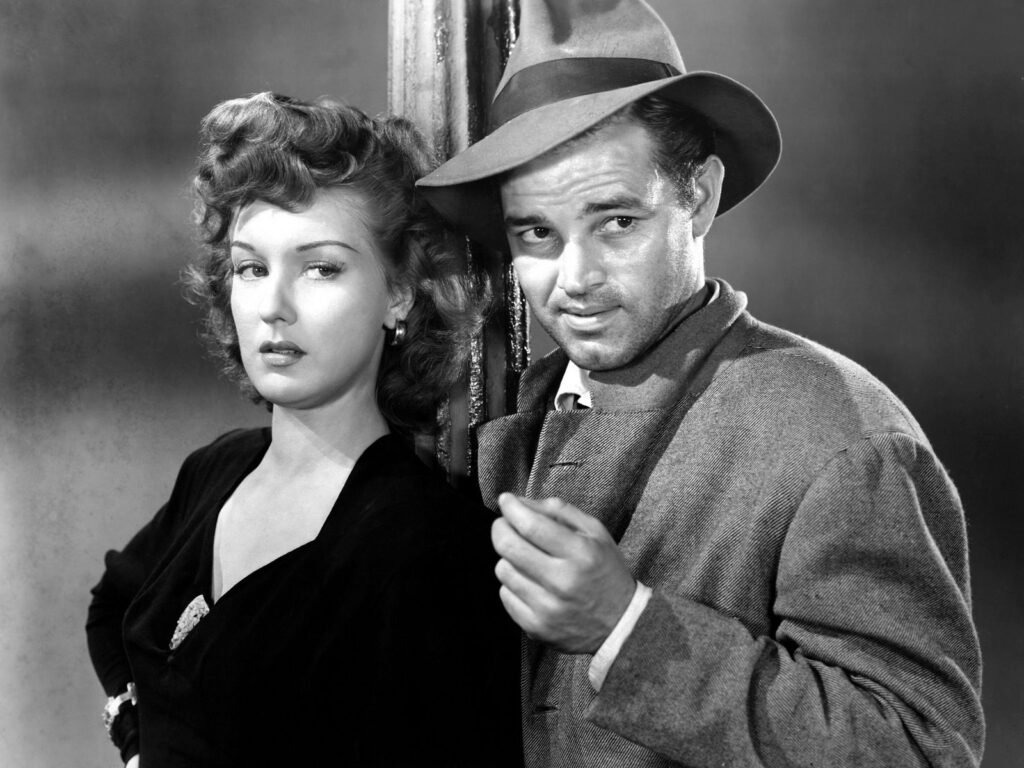
Ann Savage and Tom Neal in a publicity still for Detour (1945).
A femme fatale is a woman whose leverage puts another character’s reputation, freedom, or life at stake. Theda Bara’s Vamp uses seduction. Vera in Detour uses what she knows about a stolen identity.[1] Lilith, a precursor to the figure, has a different power: she can leave.
What Is a Femme Fatale?
Ask what she can make someone risk. Seduction can make a character gamble a marriage or a reputation. Blackmail can make him choose between exposure and a deeper fraud. The leverage and the stakes give the figure her place in the story.
Mary Ann Doane reads the femme fatale through visibility, masquerade, and the difficulty of knowing what she intends.[2] Elisabeth Bronfen asks what happens when the woman has a story and desires of her own, even when someone else gets to tell it.[3]
The Femme Fatale in Film Noir
Film noir of the 1940s and 1950s gave the femme fatale her most durable screen form. Christa van Raalte connects the figure to postwar anxieties about women’s independence and power.[4] E. Ann Kaplan’s Women in Film Noir helped establish the study of how these films depict women, sexuality, and power.[5] Julie Grossman argues that critics helped turn a varied set of female characters into the familiar “bad woman.”[6]
In Detour (1945), Al Roberts takes a dead man’s identity. Vera recognizes the car and knows Al is passing himself off as its owner. She threatens to call the police, presses him to sell the car, then sees a chance to claim an inheritance under the dead man’s name.[1] He controls the voice-over; Vera repeatedly controls what happens next.
Vera can change what Al does while they are together. She takes the telephone into the bedroom and locks the door. In Al’s account, he pulls the cord from outside and kills her by accident.[1]
Before Noir: The Vamp
In A Fool There Was (1915), Theda Bara’s Vamp draws John Schuyler away from his family and career. He keeps choosing her as the cost of the affair rises. Francia Andrade traces how Bara helped establish that screen stereotype and how later literature and film connect it to Lilith.[7]

Lilith and the Femme Fatale
In the medieval Alphabet of Ben Sira, Adam claims the superior place in bed. Lilith answers that they came from the same earth. She pronounces the Ineffable Name and leaves. When three angels pursue her, she refuses to return.[9]
In Lilith jako prefigura femme fatale, Szymon Bródka traces how a woman’s refusal of subordination becomes a sign of danger in later tellings.[10] Jessi Knippel and Leland Merritt place the first-wife story alongside the older demon traditions that helped shape Lilith’s reputation.[11]
| Question | Lilith in Ben Sira | Vera in Detour |
|---|---|---|
| What gives her leverage? | She invokes their common origin and can leave. | She knows Al is using a dead man’s identity and can expose him. |
| What does he stand to lose? | Adam loses the wife he expects to obey him. | Al risks arrest if Vera goes to the police and a bigger fraud if he goes along with her. |
| Can she get out? | Lilith leaves and stays away despite the threat to her children.[9] | Vera directs events inside the arrangement. In Al’s account, it ends with her death.[1] |

Read the first-wife narrative in Lilith, Adam and Eve, the textual distinction between biblical Lilith and later tradition in Lilith in the Bible, and the history of her demonization in Why Was Lilith Demonized?.
The Visual Grammar of the Femme Fatale
Jari K. Hietanen’s review examines how direct eye contact can affect attention and emotional response.[13] In this portrait, the eyes face the lens, the face fills nearly the entire frame, and the open mouth sharpens the expression. The close crop leaves little room for the eye to wander.

See how the pose and framing vary across the Lilith Archetype in Women series.
What Your Reaction to the Femme Fatale Says About You
I Want Her
You want to be chosen by a woman who has choices of her own.
The decisive test is whether her independence remains attractive when it frustrates you.
I Want to Be Her
You want the freedom to choose whom you desire, when to act on it, and when to walk away. Being desired is part of the appeal. So is getting to decide what happens next.
I Don’t Want Her
Which trait changes your answer? Imagine she keeps the same confidence and allure, and you can take her at her word. Would you feel differently? Now imagine she still reserves the right to leave. Where does your answer change?
Femme Fatale and Lilith Synastry
In Lilith synastry, the archetype offers a way to ask what each person finds compelling or unsettling in the other. An astrologer might read Venus contacts through attraction, Mars through pursuit, and Pluto through struggles over control. The Ascendant brings first impressions into the reading, while the fifth and eighth houses can frame questions about romance and intimacy.
References
- Hoberman, J. “Detour.” National Film Registry essay, Library of Congress. AFI film synopsis. ↩
- Doane, Mary Ann. Femmes Fatales: Feminism, Film Theory, Psychoanalysis. Routledge, 1991. Publisher page. ↩
- Bronfen, Elisabeth. “Femme Fatale—Negotiations of Tragic Desire.” New Literary History, 35(1), 2004, pp. 103–116. DOI. ↩
- van Raalte, Christa. “The Femme Fatale on Screen.” The International Encyclopedia of Gender, Media, and Communication. Wiley-Blackwell, 2020. DOI. ↩
- Kaplan, E. Ann, ed. Women in Film Noir. British Film Institute, 2nd ed., 1998. BFI / Bloomsbury. ↩
- Grossman, Julie. Rethinking the Femme Fatale in Film Noir: Ready for Her Close-Up. Palgrave Macmillan, 2009. DOI. ↩
- Andrade, Francia. “Lilith, la primera femme fatale: Estereotipos literarios y cinematográficos.” Letras, 64(104), 2024, pp. 167–190. DOI. AFI film synopsis. ↩
- Box Office Attractions Company. Theda Bara in A Fool There Was, 1915. Wikimedia Commons. Public-domain image record. ↩
- Otzar Midrashim, The Alphabet of Ben Sira, alternative version, sec. 34. Sefaria Library. Primary text. ↩
- Bródka, Szymon. “Lilith jako prefigura femme fatale.” Civitas. Studia z Filozofii Polityki, no. 21, 2017, pp. 139–153. Institute of Political Studies, Polish Academy of Sciences. DOI. ↩
- Knippel, Jessi, and Leland Merritt. “Lilith.” The Oxford Handbook of Biblical Monsters. Oxford University Press, 2025, pp. 117–132. DOI. ↩
- Collier, John. Lilith, 1887. Atkinson Art Gallery Collection. The Atkinson’s commentary on the painting and collection note on Eden Bower. ↩
- Hietanen, Jari K. “Affective Eye Contact: An Integrative Review.” Frontiers in Psychology, 2018, 9:1587. DOI. ↩